




















Blog > Ai leadership
Gorgias AI performance benchmarks for eCommerce CX Teams in 2026
Running an eCommerce support team means navigating a constant tension: automate too much and CSAT suffers; treat every customer like a VIP and costs spiral.
So what does "good" actually look like, and how do you use AI to get there?
We pulled performance data from 20+ eCommerce brands to find out.
Top CX teams hit 4.5+ CSAT, <15% AI resolution rate, and <$2 per message
The strongest teams we work with track three metrics in parallel: CSAT, AI resolution rate, and cost per inbound message. Each one pulls in a different direction, and optimizing for any single metric usually comes at the expense of the others. Landing in the top distribution across all three is genuinely industry-leading.
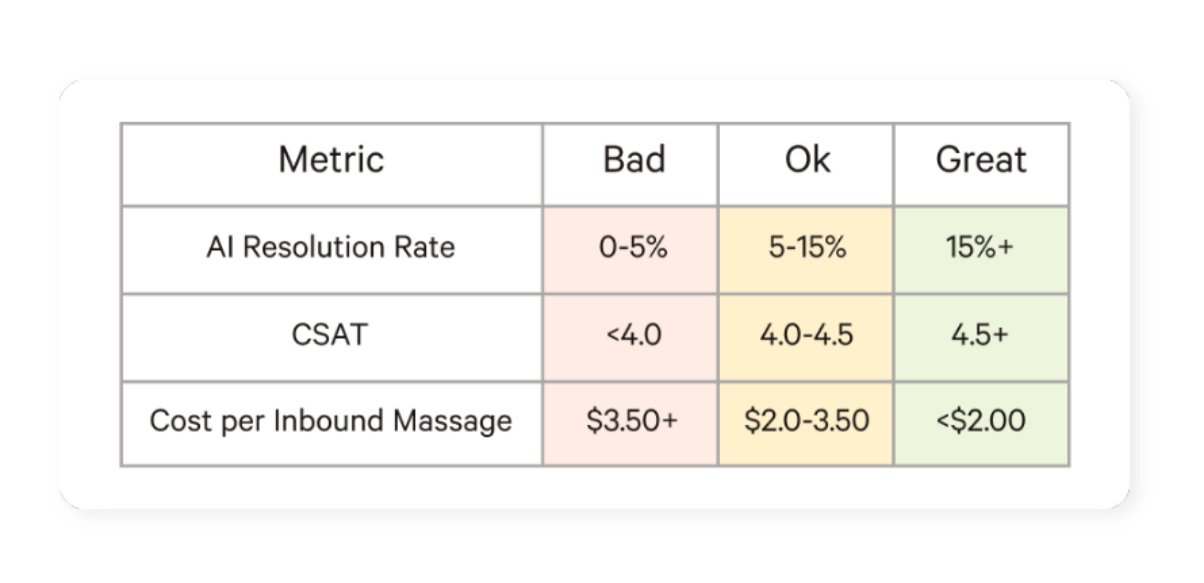
These benchmarks aren't theoretical; they instead reflect the actual operating profiles of the highest-performing teams in our analysis. The challenge, and the opportunity, is holding all three in balance.
AI resolution rate by brand
AI resolution rates across the dataset range from 0% to 51%, with a median of 10%. The distribution is heavily weighted toward the low end. Most high-performing teams sit in the 8–15% range, and none of the highest-CSAT brands exceed 20%.
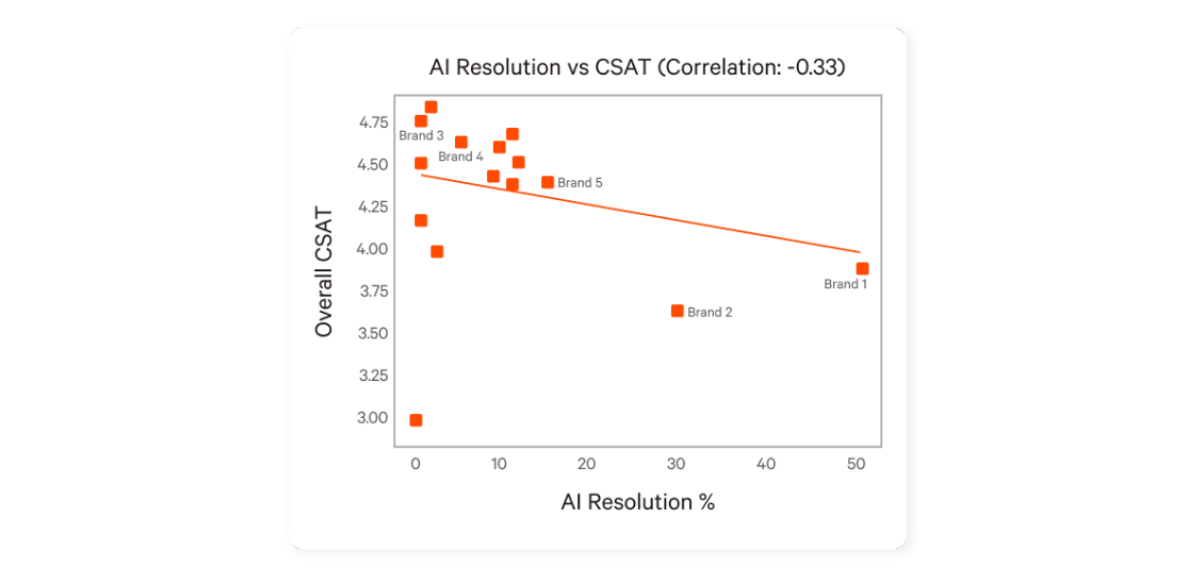
Most brands operate well below 15% AI resolution. A small group sits in the 8–15% range, while several brands are still at or near zero, indicating that AI is enabled but lightly used.
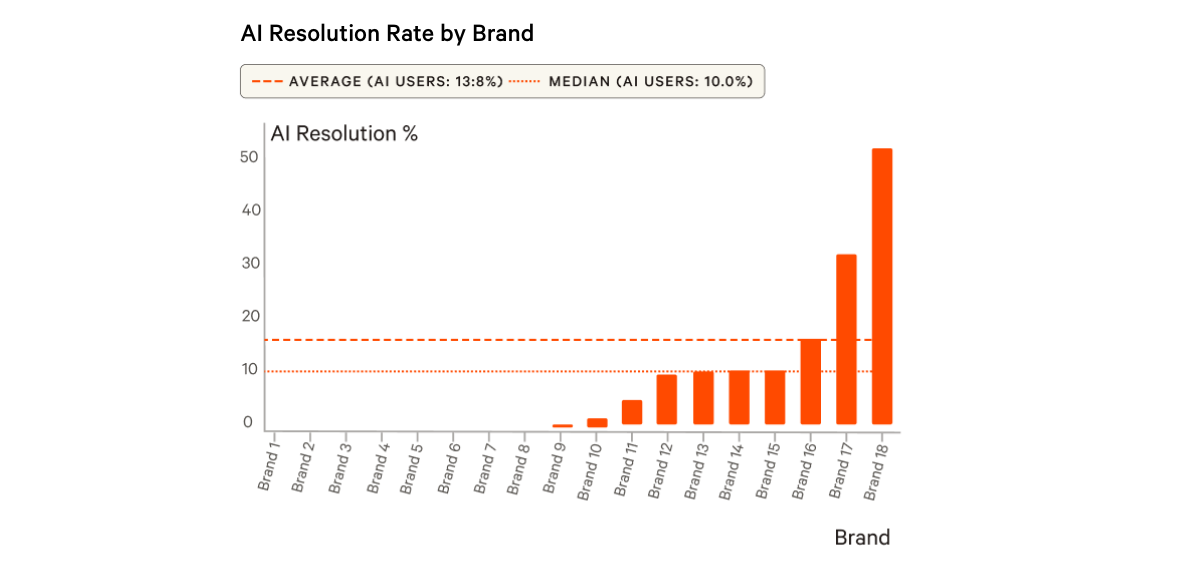
Only a limited number of brands exceed 25% automation, and just one brand in the dataset operates above 50%.
The distribution is heavily weighted toward moderate AI usage. High automation levels are the exception rather than the norm.
What's a good CSAT? 4.4 out of 5.
Across the brands analyzed, overall CSAT scores range from 2.96 to 4.90, with a median of 4.40.
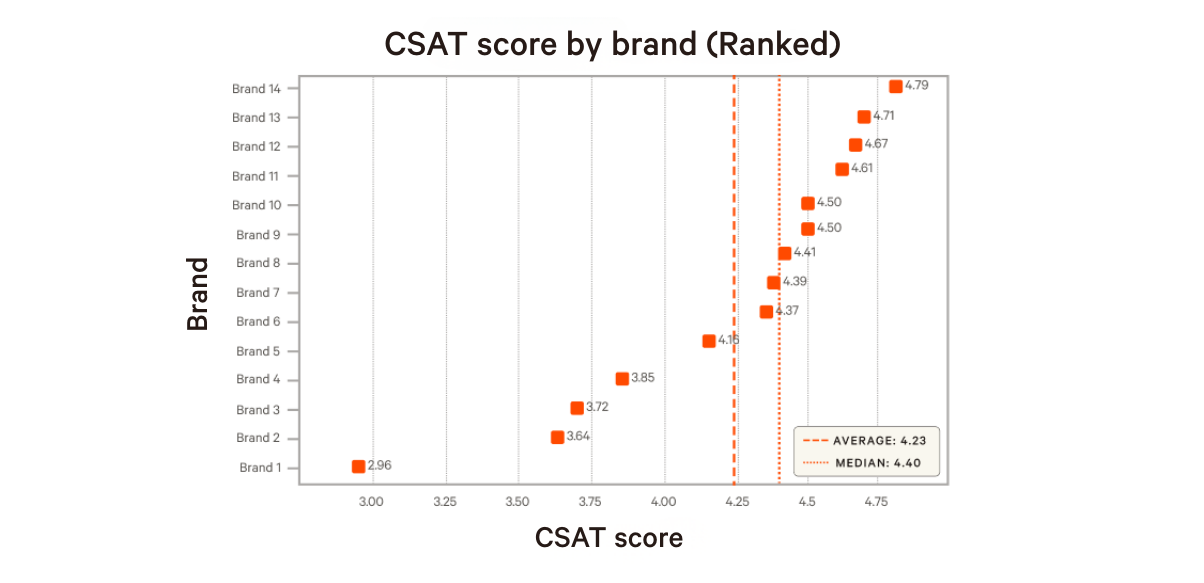
A significant portion of brands operate between 4.3 and 4.7, and several exceed 4.6. At the lower end, a small number falls below 4.0.
Note the range in acceptable CSAT for different brands. Every market and business model is different.
The most cost-efficient teams spend under $1.75 per inbound message
Cost per inbound message across the dataset ranges from $0.89 to $7.35, with a median of $2.30. The most efficient teams operate between $1.00 and $1.50.
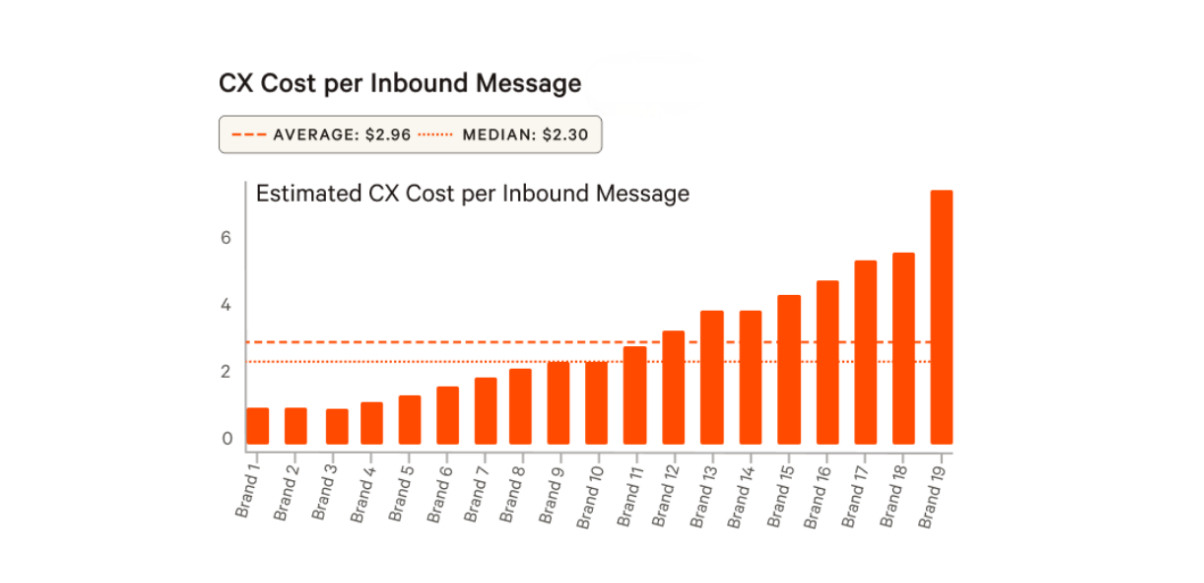
A team at $1.25 per message is running at 3x lower cost than one at $3.75, all on the same platform. The gap isn't the tool. It's the operating model: how work is structured, how agents are staffed, and how automation is governed.
Often the most efficient teams operate with humans who resolve 50-100 conversations per day. This costs less than an AI agent. The AI agent instead adds context to the tickets, which a human can then resolve quickly.
Assumptions: $0.90 per AI resolution (Gorgias AI pricing), $2,500 per human agent including management.
The real role of AI in high-performing CX teams using Gorgias AI
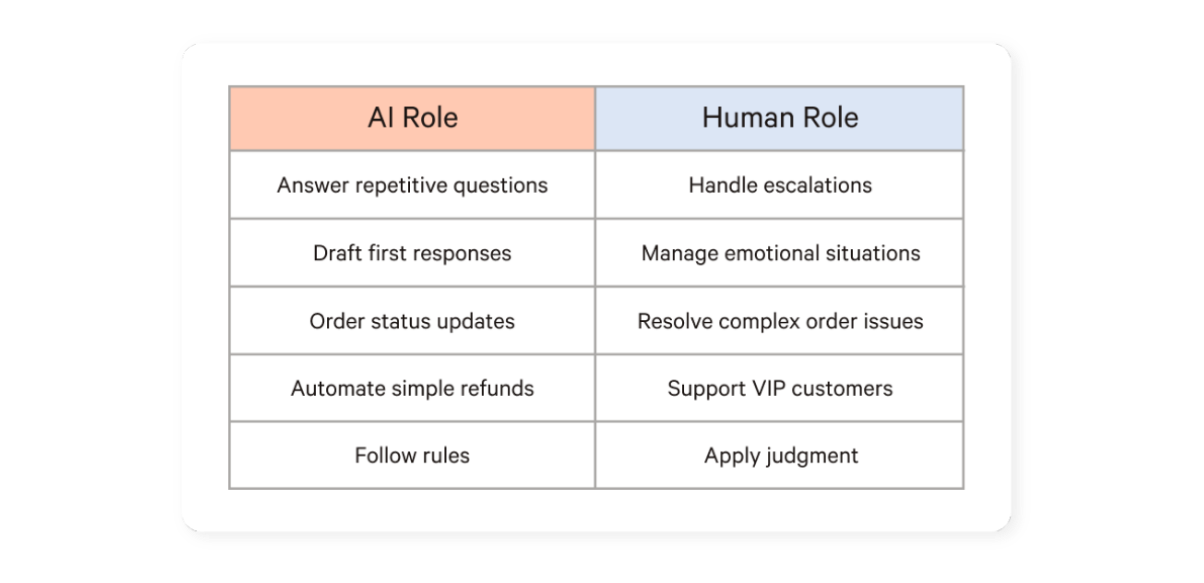
Across the dataset, the highest-performing brands treat Gorgias AI as a support layer, not a replacement for human agents.
AI is used to manage predictable, low-emotion interactions such as order status, simple returns, and first-response drafting. Human agents remain responsible for escalations, edge cases, VIP customers, and situations that require judgment.
The objective is not maximum automation. It is balancing cost and CSAT with AI used as a massive lever, where appropriate.
The pro-level CX Gorgias AI operating model
Based on the highest-performing teams in this dataset, a strong operating model consistently includes three elements: clear targets, defined structure, and disciplined governance.
Target metrics * CSAT: 4.6+ * AI resolution: 10–20% * Cost per message: ~$1–$1.75
Team structure * 70–80% L1 agents handling high-volume workflows * 10–20% L2 specialists managing escalations and complex cases * 1 team lead per 8–12 agents * Gorgias AI handling repetitive Tier 1 flows
Top teams are not attempting to automate everything. They define clearly which interactions AI customer support owns and which remain human.
That clarity is what protects both efficiency and experience.
The top 5 moves to make your team better
Across the dataset, the strongest teams consistently demonstrate five operational habits:
- Automate the top 3–5 ticket types: Typically: order status, returns, exchanges, shipping updates, basic product questions
- Keep AI in the 10–20% resolution band: Enough to drive efficiency. Not enough to erode experience.
- Segment work by complexity: Ensuring high-volume tickets and escalations are clearly separated.
- Measure cost per message weekly: This is the clearest efficiency signal in CX operations.
- Treat AI like a junior agent: It requires training, QA, monitoring, and ongoing management.
In conclusion
AI on its own is not the future of customer support. AI-empowered teams are.
The brands leading in CX are NOT those with the highest automation rates. They are the ones that balance speed, cost, empathy, and judgment.
Across this dataset, that balance consistently reflects moderate AI usage paired with strong human ownership.
If interested in building an AI-first CX org that costs less than $2 per inbound message with a CSAT of 4.4+. Get in touch here.
Or, read more about AI implementation and management.
Get started with Influx
Influx was established in 2013 & has been trusted by 750+ brands globally, ranging from startup to scale.
Influx builds 24/7, near-shore global customer support teams. We provide fully managed, flexible & high-performance agents. Our services range from eCommerce support, tech support, sales support, AI Management, Enterprise solutions and more to give you the customer assistance you need to prioritize other responsibilities and continue scaling your business.
Make your support operations fast, flexible, and ready for anything with experienced, 24/7 support teams working on demand. See how brands work with Influx to deliver exceptional customer support or get a quote now.
Read these next
Or read our client testimonials or case studies
 6 Circle - small.png)